
The current Plumb family has thirty-five individual module portraits and four miniature record companions. The original core identity and two complete family plates are retained. Artwork explains roles; it does not claim acceptance, completed epics or customer benefit.
Brand guide · Module mapping · Vector geometry · Prompts · Hashes and provenance
Plumb family v2
Open the illustrated catalogue to see every character, its job and its full-size PNG. Each module guide also carries its own portrait.
- 39 standalone assets: 35 module portraits and 4 concept companions; transparent PNG, complete uncropped canvas.
- Method: built-in image_gen, using the original Plumb master as the identity reference. Individual prompts, canonical mappings and descriptions are recorded in the family specification.
- Provenance: dimensions, alpha verification and content hashes are recorded in family v2 provenance. The older provenance below continues to describe only the original assets.
- Commissioned, then generated: the 15 most recent module portraits were ordered in the portrait commission, each with its direction, nickname and alt text. They were generated with the built-in subscription image_gen tool, not with the API-key script
scripts/generate-portraits.ts; the commission'sgpt-image-2.5is the model it requested, and the tool does not expose the model it actually used. Their hashes are in the family v2 provenance, with the final prompts and review record. The owner authorised final Codex self-review and shipping after Opus/Fable became unavailable; earlier independent passes are recorded separately. No portrait is pending. - Reuse: canonical names and meaningful alt text accompany portraits. Use module portraits at 192 px or above; companions at 96 px or above. Preserve the loop, prop and complete canvas. Colour is never operational meaning.
Workflow ensembles
- Ten mechanical ensemble plates: one for each Workflow with at least two portrayed Modules, and one for the Factory, shown on the composition map. Each hangs the members' family-v2 portraits, downscaled whole, from one ink rail through their own loops. Every opaque pixel is kept; nothing is cropped, recoloured or redrawn, and no two characters overlap.
- Method and provenance:
node scripts/compose-ensembles.tscomposes them from the composition data; ensemble provenance records each member's source hash, scale and position and each plate's hash, and--checkfails on drift. - Commissioned, not generated: illustrated scenes in which the members work together are commissioned for
gpt-image-2.5in the ensemble commission. None has been generated; a scene replaces a plate only through a reviewed change with provenance.
Original module family plates
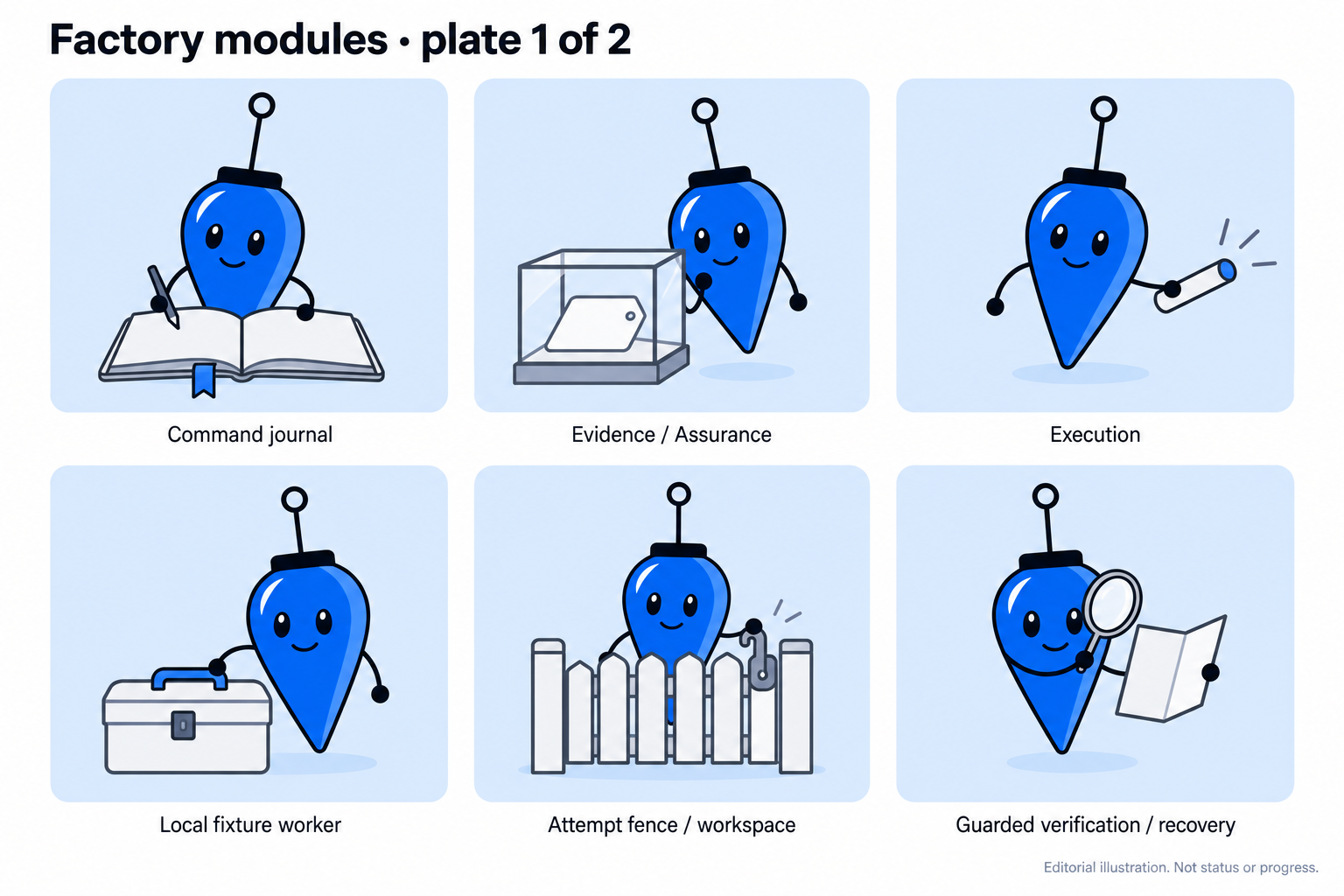
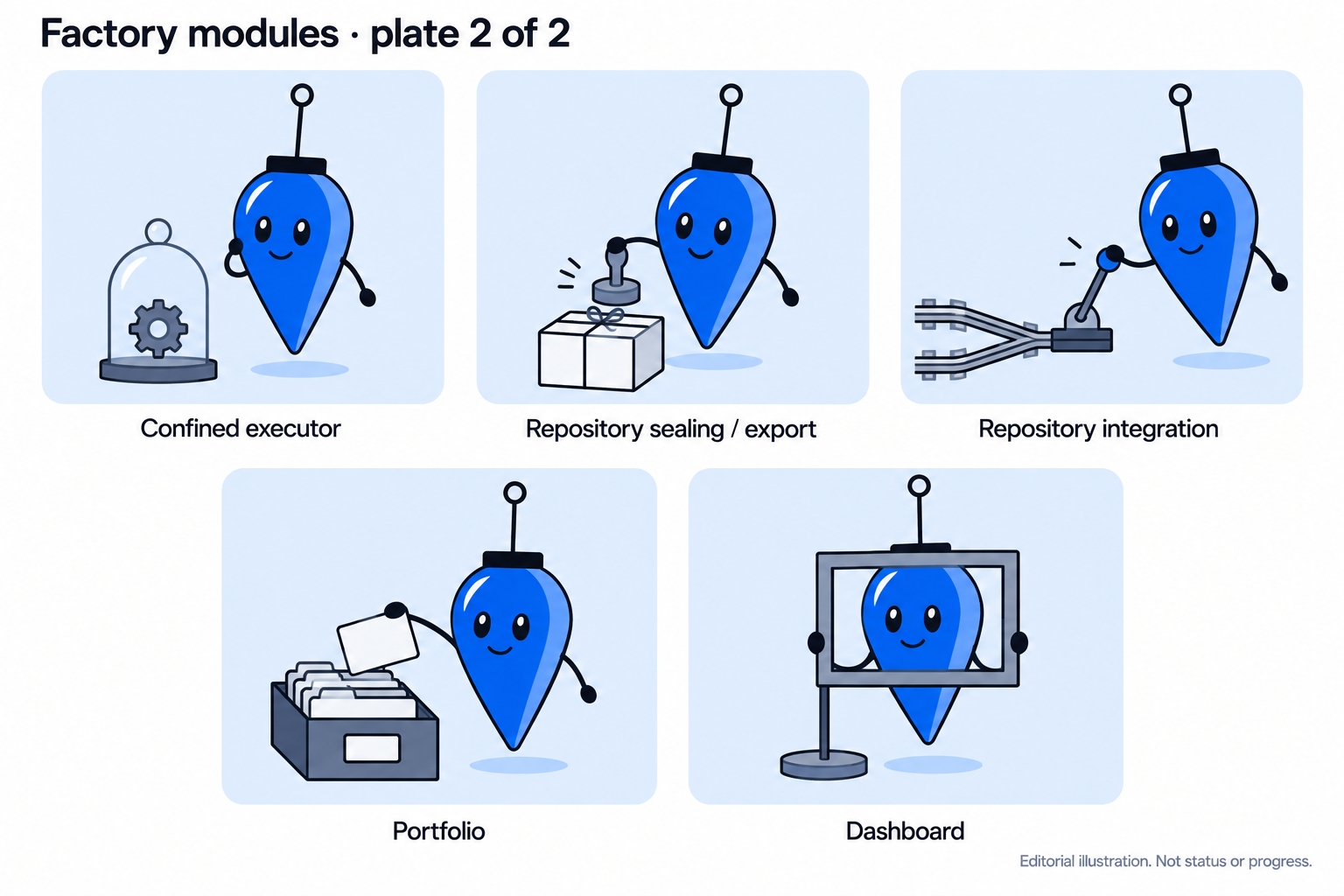
Exact labels and reading-order positions are available as text in the module table. Keep each plate intact. Future decision-domain directions are documented there; no extra images are owed yet.
Core identity


| Asset | Actual dimensions | Method / background | Use |
|---|---|---|---|
| core-plumb-mascot | 1254 × 1254 | image_gen; genuine alpha | Character reference; docs and optional onboarding. |
| core-factory-mark | 1254 × 1254 | image_gen; genuine alpha | Mark beside Factory; minimum 48 × 48 px PNG canvas. Not an approved favicon. |
| study-modules-plate-1 | 1536 × 1024 | image_gen; white, RGB | Module positions 1·1–1·6. |
| study-modules-plate-2 | 1536 × 1024 | image_gen; white, RGB | Module positions 2·1–2·5. |
| Factory lockup | 312 × 110 SVG view box | Original hand-authored vector; transparent | Docs and headers; check at the actual placement size. |
The generated core PNGs are 1254 × 1254, although 1024 × 1024 was requested. All PNGs are unchanged generator outputs, not crops. The SVG is original vector artwork, not image_gen output; its live system-font wordmark can vary by viewer.
Original identity review and shared use
- Exact Opus 5.5 at configured high effort supplied the original direction and correction. Astra coordinated image_gen and independently reviewed the direction, sources, labels, consistency and delivered files. The image tool did not expose its underlying model. Full hashes, prompt hashes and source receipts are in provenance.
- Visual comparison at 16, 24, 32, 48 and 64 px rejected the original 16 px mark claim. Use the generated mark at 48 px or larger.
- Foreground token contrast is checked in geometry. Pale backgrounds and shadows are decorative, not information. Raster studies retain small tonal variation; they are illustrations, not exact vector exports.
- Supply meaningful alt text, or empty alt text when a neighbouring text equivalent makes an illustration decorative. Never make an illustration the sole label or control.
- The identity mark may accompany Factory in navigation. Characters belong in docs, onboarding or calm empty states, through ordinary reviewed design-system changes; operational messages stay plain.
- Completed-epic packs: none. All 27 epics were open at capture. Follow the asset rule when independent closure evidence exists.
Proposed Knowledge character
The Knowledge design has a separate transparent weaver study with original provenance. Existing family portraits and their provenance stay unchanged. Preservation review establishes neither a Knowledge implementation nor family-portrait acceptance.