
Visual understanding · Workflow diagrams
These are information-flow diagrams, not import graphs. Arrows mean a caller passes or records information; they do not imply automatic dispatch. Contracts own exact field names and bounds; the build review owns current acceptance.
- Calendar
- Command journal
- Execution
- Attempt fence / workspace
- Local fixture worker
- Evidence / Assurance
- Guarded verification / recovery
Calendar
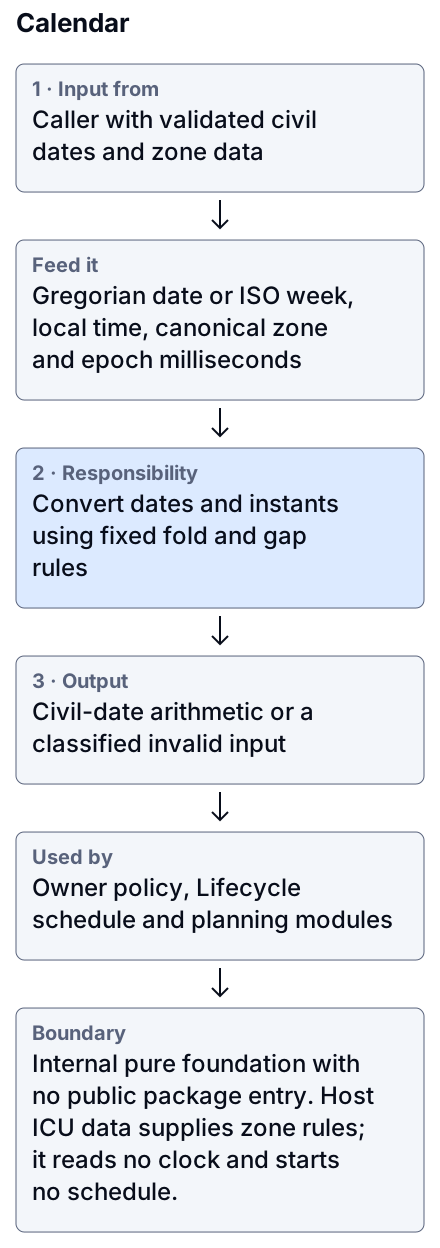
Feed it: Gregorian date or ISO week, local time, canonical zone and epoch milliseconds. Supplier: Caller with validated civil dates and zone data.
Use its result: Civil-date arithmetic or a classified invalid input. Consumer: Owner policy, Lifecycle schedule and planning modules.
Boundary: Internal pure foundation with no public package entry. Host ICU data supplies zone rules; it reads no clock and starts no schedule.
Human guide · Exact contract · Open full-size diagram
Command journal
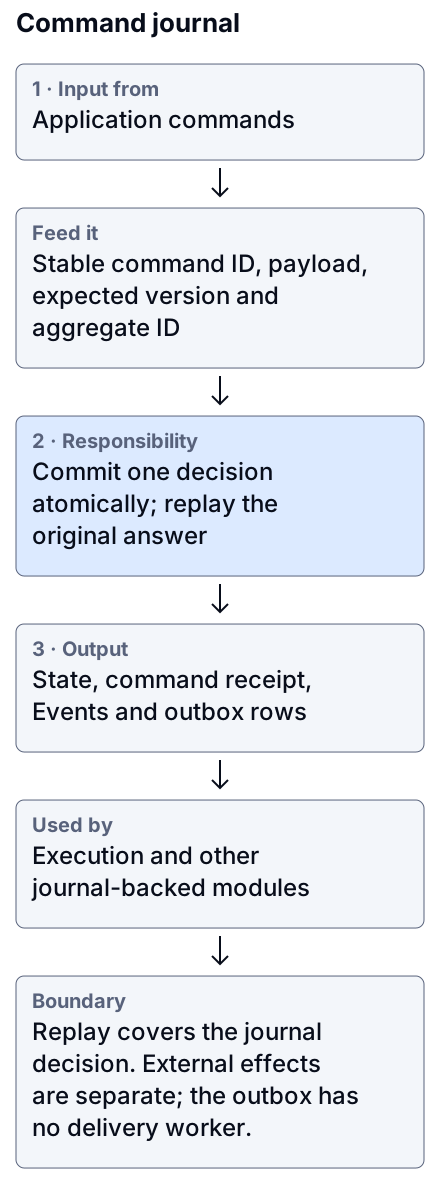
Feed it: Stable command ID, payload, expected version and aggregate ID. Supplier: Application commands.
Use its result: State, command receipt, Events and outbox rows. Consumer: Execution and other journal-backed modules.
Boundary: Replay covers the journal decision. External effects are separate; the outbox has no delivery worker.
Human guide · Exact contract · Open full-size diagram
Execution
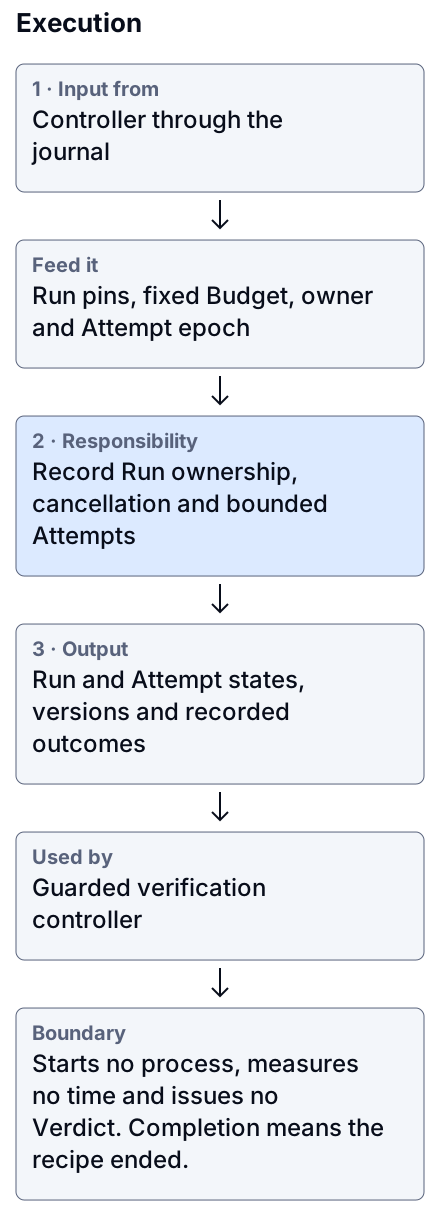
Feed it: Run pins, fixed Budget, owner and Attempt epoch. Supplier: Controller through the journal.
Use its result: Run and Attempt states, versions and recorded outcomes. Consumer: Guarded verification controller.
Boundary: Starts no process, measures no time and issues no Verdict. Completion means the recipe ended.
Human guide · Exact contract · Open full-size diagram
Attempt fence / workspace
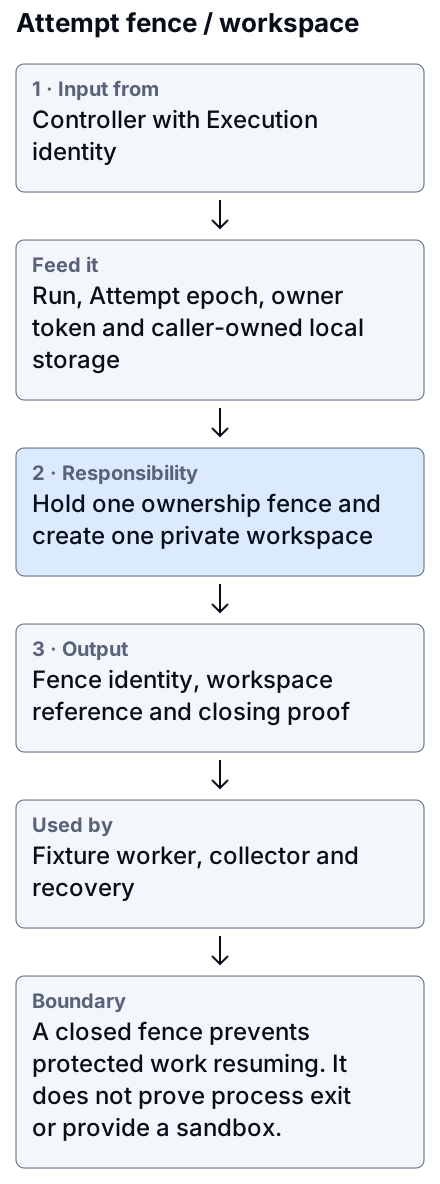
Feed it: Run, Attempt epoch, owner token and caller-owned local storage. Supplier: Controller with Execution identity.
Use its result: Fence identity, workspace reference and closing proof. Consumer: Fixture worker, collector and recovery.
Boundary: A closed fence prevents protected work resuming. It does not prove process exit or provide a sandbox.
Human guide · Exact contract · Open full-size diagram
Local fixture worker
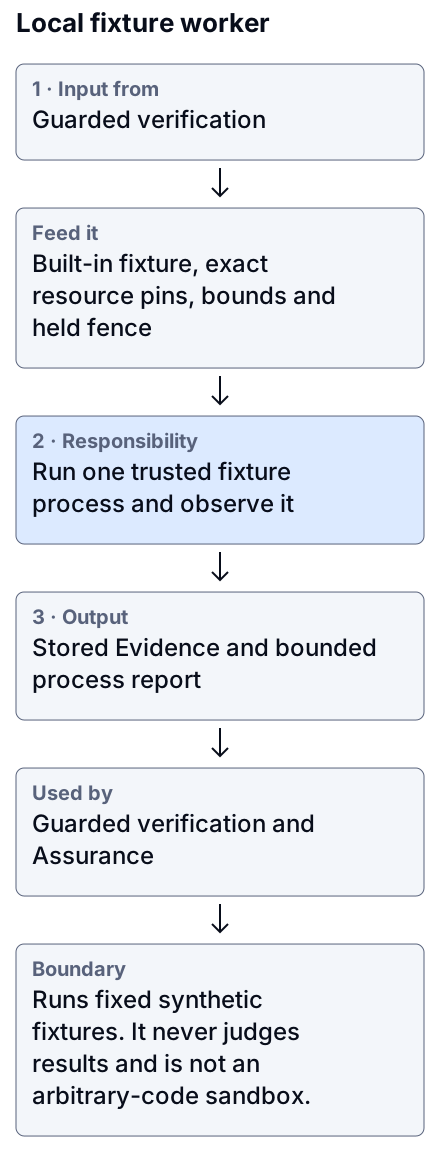
Feed it: Built-in fixture, exact resource pins, bounds and held fence. Supplier: Guarded verification.
Use its result: Stored Evidence and bounded process report. Consumer: Guarded verification and Assurance.
Boundary: Runs fixed synthetic fixtures. It never judges results and is not an arbitrary-code sandbox.
Human guide · Exact contract · Open full-size diagram
Evidence / assurance
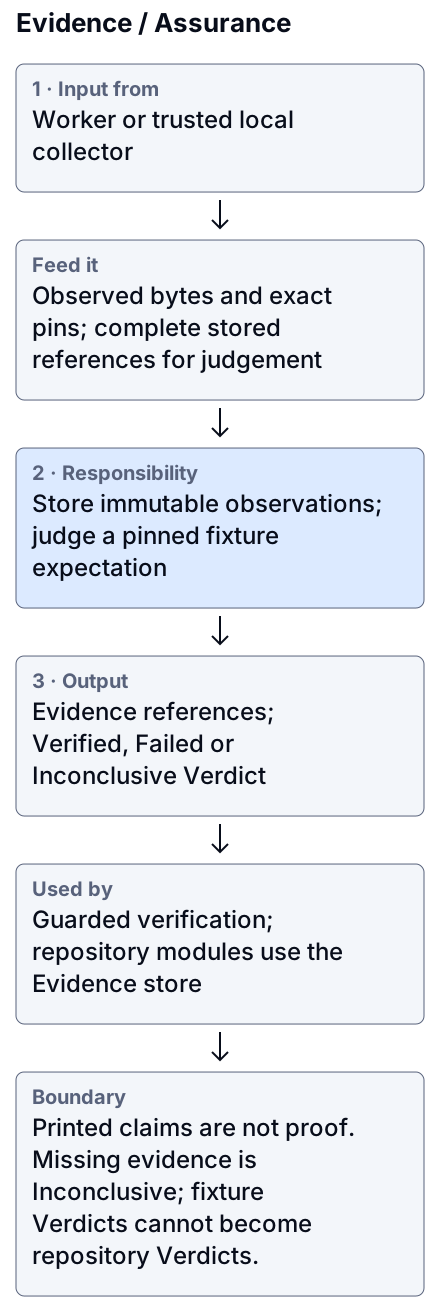
Feed it: Observed bytes and exact pins; complete stored references for judgement. Supplier: Worker or trusted local collector.
Use its result: Evidence references; Verified, Failed or Inconclusive Verdict. Consumer: Guarded verification; repository modules use the Evidence store.
Boundary: Printed claims are not proof. Missing evidence is Inconclusive; fixture Verdicts cannot become repository Verdicts.
Human guide · Exact contract · Open full-size diagram
Guarded verification / recovery
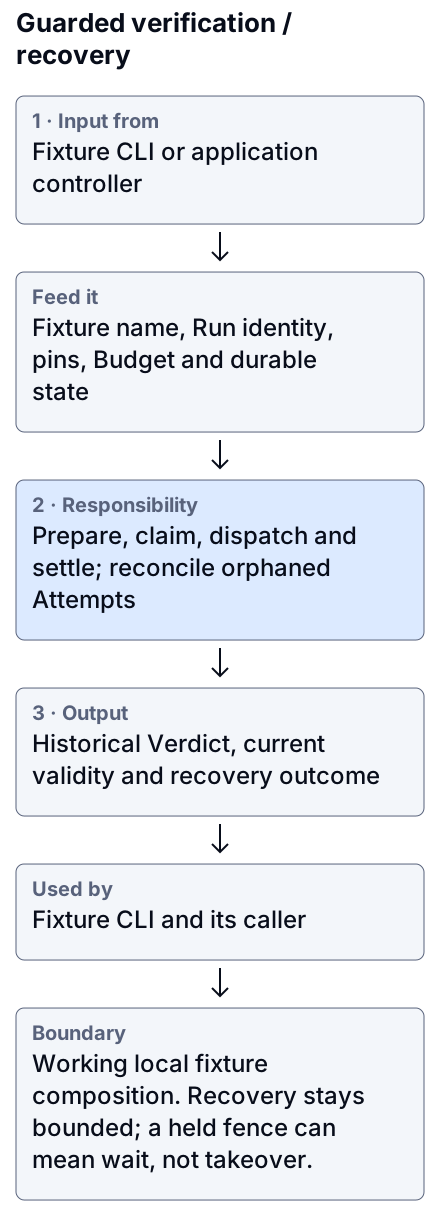
Feed it: Fixture name, Run identity, pins, Budget and durable state. Supplier: Fixture CLI or application controller.
Use its result: Historical Verdict, current validity and recovery outcome. Consumer: Fixture CLI and its caller.
Boundary: Working local fixture composition. Recovery stays bounded; a held fence can mean wait, not takeover.